
I believe that growth happens just outside our comfort zone – when something stretches you slightly further than feels comfortable. It’s easy advice to give and considerably harder to take. I also believe that you shouldn’t expect others to do something that you wouldn’t do yourself.
So a while back, I challenged myself to do something that made me step outside of my comfort zone. I signed up for improv classes.
They remain one of the best learning experiences I’ve had, and I think that’s precisely because they were experiential. Nobody handed me a framework. Nobody talked me through a model of collaborative decision-making. I just had to stand up in a room and experiment – and often do it badly – in front of strangers, which turns out to be a far more efficient way to learn than reading about it ever is.
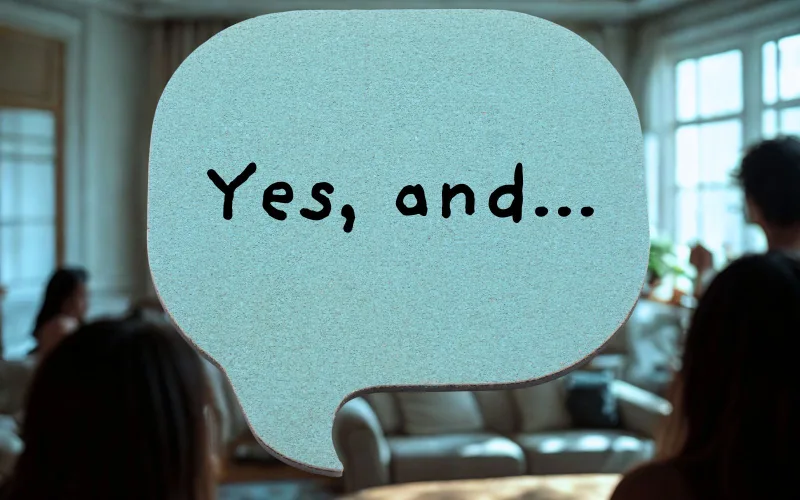
What struck me about those sessions, was how closely the rules of improv map onto the traits of high-performing teams. There’s a whole set of improv rules, but the one that matters most – the one you’ve probably heard of even if you’ve never set foot in an improv class – is “yes, and.”
“yes and” is about building
In improv, you never block what your scene partner gives you. You accept every idea and build on it. Someone says “isn’t it strange that this bus is underwater,” Your job is to accept what’s been offered and build on it. “Yes and, which stop do you need” Say no, buses don’t go underwater and the scene dies. Say “yes, and,” and it has the potential to go somewhere neither of you had planned.
That’s not just an improv performance trick. It’s what good disagreement looks like too. Not “no, you’re wrong,” but “yes, and here’s what I’d add, or change, or worry about.” The idea survives contact with a different opinion and develops instead of getting shut down.
I regularly steal exercises directly from improv and use them with teams. And I’ll be honest about what happens the first time: it feels contrived. For example, grown adults standing in a circle, building a story one word at a time, are acutely aware that they’re playing a game, and playing games at work can feel a bit odd when you’re not used to it.
I do it anyway, because practicing the discomfort can be part of the point. New behaviours that lead to new ideas need to be practised somewhere low-stakes before they show up somewhere that matters, and rehearsing “yes, and” out loud, in a slightly silly exercise, is what starts building new neural pathways and making the “yes and” feel like a natural response.
Here’s what I’ve noticed though: in the real world, nobody clocks it. Say “yes, and” in an actual conversation, the other person doesn’t think “ah, that’s a training technique.” They just notice that you engaged with what they said instead of dismissing it. And if someone does spot it – if they say “have you been on one of those courses?” – that’s fine too. You can just say yes, and – it’s working, and get on with the conversation.
We don’t need to shy away from or disguise the “yes and” technique. It is a simple way to get to a better outcome by not shutting an idea down before it’s had a chance to breathe, a way to build on what someone else has said, a way to show you’re listening and a way to have a disagreement dialogue that might just reach a resolution. Give it a go and let me know how you get on.
‘How to disagree’ is just one of the topics in the Lucidity success System – my methodology for high performing teams. All the Success System modules are available inside Lucidity Learning. Here’s your link to join today.