
Recently I’ve been writing about what happens in our brains when we face uncertainty – why we resist change, why we procrastinate, why we cling to familiar ways of working even when they’ve stopped serving us. This post is about one of the most practical tools available to you when you’re wrangling with a difficult decision and the right path still isn’t clear: your values.
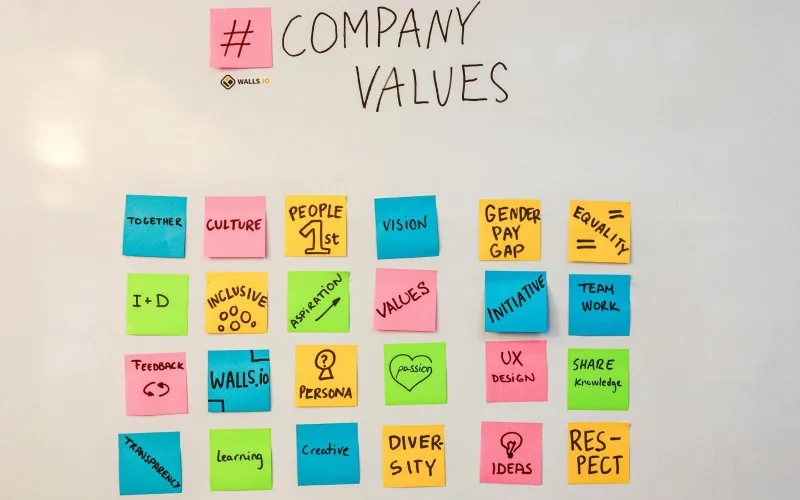
Most organisations have a set of values. For some they sit in a dusty file. For others they are on the wall – lip service to the consultant who said values are important. And sometimes they are real: built with employees, reflected in behaviours, genuinely part of how decisions get made and how people treat each other. That is the version of values worth having. Not because it looks good on the website but because it gives everyone – including you – a shared reference point for how to act when things get complicated.
The difference between values as lip service and values as a useful tool comes down to whether people know what they look like in action. “We value integrity” is a start. But what does integrity look like when you’re deciding whether to share difficult financial news with your team, or when a senior colleague is behaving in a way that contradicts what the organisation says it stands for? Values become useful when they guide you to make a decision in a specific situation.
This is where personal values and organisational values both come in – and where the relationship between them matters.
At their best, the two reinforce each other. You believe in the mission, you trust the way the organisation goes about its work, and when a difficult decision lands you have two complementary anchors. The question “what would the best version of me do here?” and the question “what would our organisational values ask of us here?” point in the same direction.
But organisational values can drift. The stated values and the lived values can start to diverge. The organisation says it values transparency but information gets hoarded. It says it values its people but learning and development is the first thing cut when money gets tight. It says it values innovation but new ideas get quietly suffocated. When this happens, a leader with strong personal values starts to feel the friction. Something is off, even when it’s hard to name exactly what.
Pay attention to that friction. It is not necessarily a reason to declare a crisis – but it is a signal that something needs to be named and addressed rather than quietly absorbed.
Which brings us back to you, and to uncertainty. When you are facing a decision that doesn’t feel clear – when the right path isn’t obvious and the pressure is on. Alongside gathering information, thinking it through, and asking advice from others – your values are one of the most reliable anchors you have.
Next time you’re wrangling with a difficult decision, here are some questions to ask yourself that connect to your values that might help you think more clearly:
- How do I feel about this situation?
- What would the [insert appropriate value] version of me do here?
- Is this decision consistent with what I say I stand for – and with what my organisation says it stands for? If yes, what does that tell you? If not, why not?
- If I look back on this decision in five years, will I be comfortable with the choice I made?
These questions don’t always produce easy answers. But they can help when you’ve been sitting with a decision for too long, going round in circles, waiting for more information that probably won’t change the essential choice, or trying to find an option that keeps everyone happy. Sometimes what cuts through the noise isn’t more data – when faced with uncertainty – it’s knowing what you stand for and being willing to act on it.
Your values are a filter. Run the decision through them and see what comes out the other side.
Values-led leadership isn’t a communication style or a personality type. It is the discipline of knowing what you stand for clearly enough to use it.
If this resonates and you’d like more practical thinking for leaders navigating change and uncertainty, sign up for the Lucidity email – I drop practical tips and tools into your inbox every week.
P.S. One of the things I do in coaching is help leaders get clear on what they stand for – not as an abstract exercise but as a practical tool for the decisions they are facing right now. If that sounds useful, book a call and let’s talk.