

When teams struggle with innovation, the instinct is often to look for better tools. A new technology to synthesise insights, different ways to generate ideas, or methodologies, theories, and frameworks to unlock creativity.
But the truth is that successful creativity and innovation need space to think and courage to ask interesting questions that help identify the problems that need solving.
The environment we work in is important because innovation often happens in moments – when someone shares a half-formed idea, asks a question that others haven’t considered, or challenges the direction of travel. And all of those moments rely on one thing: people feeling safe enough to speak up.
Without that, ideas stay unspoken, questions go unasked, and thinking stays the same.
The hidden impact of anxiety on innovation
One of the biggest barriers to creative thinking and innovation is feelings of stress, overwhelm, and anxiety.
It’s not always obvious, but if you observe closely, it shows up in how people behave. Things like hesitating before contributing, holding back on sharing a different perspective, or waiting until an idea feels ‘fully formed’ before being brave enough to say it out loud.
From the outside, everything can look fine. Work is getting done. Deadlines are being met. But under the surface, people are playing it safe.
When we feel anxious, our thinking shifts. Our brain responds to a perceived threat and we focus more on staying safe and avoiding mistakes than exploring possibilities. We look for the ‘right’ answer rather than considering different options. We stick with what we know. And that’s when creativity starts to erode.
The safety and accountability matrix
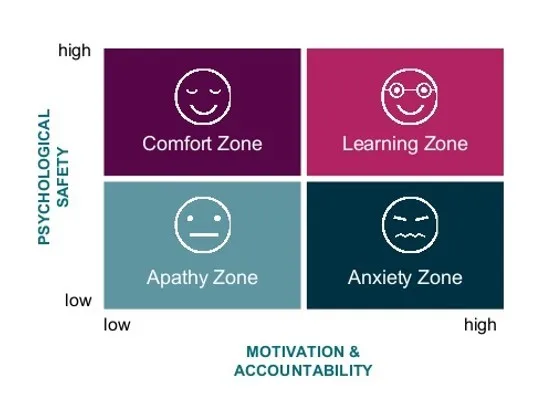
Amy Edmondson’s psychological safety and accountability matrix helps make sense of this. It looks at two conditions: psychological safety – how safe people feel to speak up, take risks, and make mistakes – and how accountable they are for results.
- Apathy Zone (Low Safety, Low Accountability): Energy is low, and innovation is almost non-existent.
- Comfort Zone (High Safety, Low Accountability): People contribute, but without stretch, performance and progress plateau.
- Anxiety Zone (Low Safety, High Accountability): Expectations are high, but people don’t feel able to speak up. They filter what they say, avoid risk, and focus on not getting it wrong.
- Learning Zone (High Safety, High Accountability): People share ideas early, challenge thinking, and take intelligent risks. This is where psychological safety for innovation creates high performance.
What building psychological safety means in practice
Many teams operate in the anxiety zone without realising it. There is pressure to deliver, but not always the conditions that support psychological safety for innovation and creative thinking.
Over time, this limits what’s possible. Problems are raised too late, and mistakes are covered up. Ideas aren’t explored, and the same thinking gets repeated.
The shift from the anxiety zone into the learning zone doesn’t come from a new tool. It comes from everyday leadership behaviour. For example:
- How you respond when someone speaks up.
- Whether different perspectives are genuinely welcomed.
- How mistakes are talked about and learned from.
These small behaviours shape whether people feel safe to contribute. When people feel safe, the quality of thinking changes. Conversations become more open, ideas develop more quickly, and creativity and innovation become part of how the team works – not something extra to try and ‘fit in’.
If you want to go further
I work with teams to help them embed a culture where innovation and creativity can thrive. If you’d like to explore what psychological safety for innovation could look like for your team, get in touch and we can arrange a time to chat.